
Publication · 22 novembre 2026 · 5 min Lesezeit
Elevator entrapments, leaks and flooding: preparing security guards for building emergencies
A proposed Boston ordinance lists elevator breakdowns, water leaks and power outages next to first aid and de-escalation in guard training. What these calls involve, what every post order should answer, and where practice in VR fits.
Von SkillCamp Redaktion
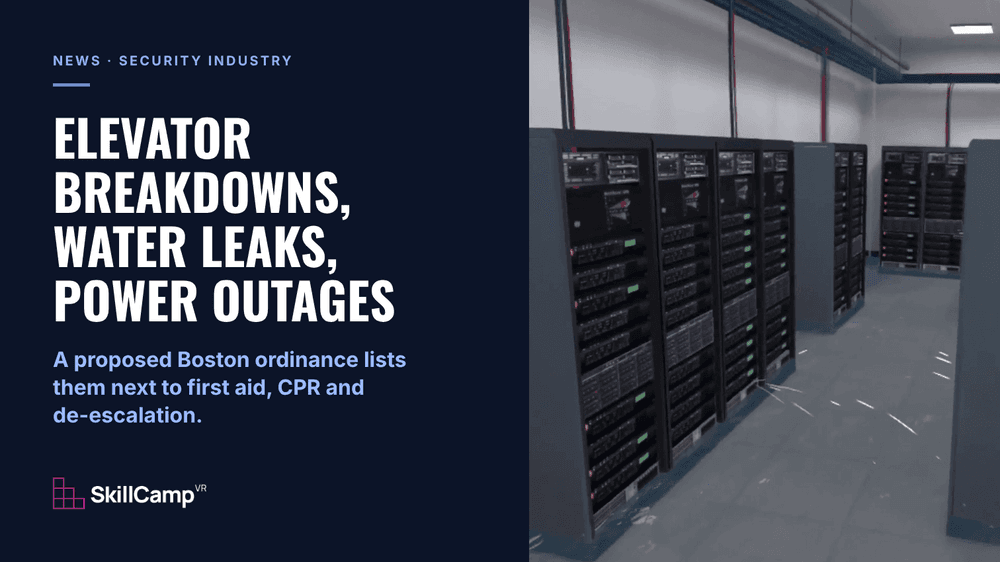
A guard's training usually starts with people: conflict, access control, medical emergencies. A proposal in Boston puts something else on the same list: the building itself. Elevators that stop between floors, pipes that burst, power that goes out. Here is what the proposal says, why these calls deserve their own place in training, and how to prepare people for them.
What Boston is discussing
On 17 November 2026 the Boston Globe reported that the Boston City Council is considering an ordinance on minimum training for unarmed security guards. According to the article and the ordinance text (Docket #1541):
- Guards would complete at least 40 hours of in-person training through a city-certified program, and 8 hours of recurrent training every year after that.
- Security employers with two or more unarmed guards at a covered property would need an annual permit and would have to keep training records.
- Employers would pay for the training and for the time spent on it.
- The required topics include first aid, CPR and AED use, overdose response, de-escalation, fire and building safety, incident reports, and responding to disruptions in building operations: electrical outages, water leaks, flooding, elevator service disruptions and elevator entrapments.
It is a proposal, not a rule. The mayor had not taken a position when the Globe reported, and several security firms told the council the plan is too rigid and too costly. Whatever happens in Boston, the list is worth reading, because it describes the job as guards actually experience it.
Why building disruptions belong in guard training
Our view: at night and at weekends, the guard is often the only person on site who is awake and responsible. When an elevator stops with someone inside, or water spreads across a technical room, the first minutes depend on what that person does.
These events are rare at any single site. That is exactly the problem. Few guards have handled one before, and nobody wants to stage a flood or trap a colleague in an elevator to practise. So the response often lives only in a binder.
What every post order should answer
Procedures differ by building, client and local rules, so we do not prescribe steps here. But for each of these situations, the site's post orders should give the guard clear answers to a few questions.
A person trapped in an elevator
- Who is called first, and in what order: the elevator service company, the building engineer, emergency services?
- How does the guard stay in contact with the person inside, and what do they say?
- What must the guard not do while waiting for specialists?
- What goes into the report, and to whom?
Water leaks and flooding
- Where are the shut-off valves, and who is allowed to close them?
- When is a room unsafe to enter because water and electricity may meet?
- Who must be informed: facility management, IT for server rooms, the client contact?
- If a pump is used, who sets it up and how?
Power outages
- What happens to access control, alarms and elevators when the power goes, and what does the guard check first?
- Where are emergency lighting and backup systems, and how is their status confirmed?
For all of them
- What exactly is recorded: time, location, actions, who was informed, when specialists arrived?
If a new guard cannot answer these for their own post, the gap is not in their motivation. It is in the preparation.
Where practice in VR fits
Reading a procedure and doing it under pressure are different things. Several of these situations are already scenes in our VR library:
- a person trapped in an elevator: identifying the right emergency call chain and reporting to specialists
- a leaking tap found on a round
- a flooded technical room and a flooded server room, where the trainee has to recognise the short-circuit risk
- deploying a pump during flooding
- a small office fire found during a room check
- a person who is not breathing: CPR step by step
- a damaged door: documenting the findings and reporting
Power outages and overdose response are not part of these scenes.
A session takes about 20 minutes on a standalone headset at the workplace. If the trainee gets it wrong, the scenario shows the consequence and they go again. Each attempt is recorded in a profile per person, so a manager can see who has practised what, at which site.
VR does not replace a certified course, a site walk-through or the client's own procedures. It adds repetitions between courses, for the situations a guard should never meet for the first time on a real shift.
A short checklist for the next review of your post orders
- List the building disruptions that can happen at each site: elevators, water, power, fire.
- Check that the post orders answer the questions above for each of them.
- Make sure every guard on every shift, including nights and weekends, has practised the response at least once.
- Keep a record per person, not a sign-in sheet.
Whatever Boston decides, these are the calls your guards will get. The question is whether the first time they handle one is in training or at 3 a.m.
Sources: Boston Globe, "Boston City Council mulls training for unarmed security guards", 17 November 2026; City of Boston, Docket #1541, An ordinance establishing minimum training requirements for unarmed security guards.
Weitere Artikel
AI in security guarding: why a ban is not enough
Many security officers ask private AI apps about rules, even where this is banned. What that means for client and site data, six questions to ask any AI provider, and how BDSW member companies can test a governed AI for three months free of charge.
20 octobre 2026 · SkillCamp Redaktion
Lire la suite →
The ROI of VR training: where the money actually comes from
The headset is rarely the cost that matters. Where VR training pays back in practice: shift cover, trainer time, travel, error risk and audit records. With the Securitas figures, an example calculation and the five numbers to collect for your own.
20 septembre 2026 · SkillCamp Redaktion
Lire la suite →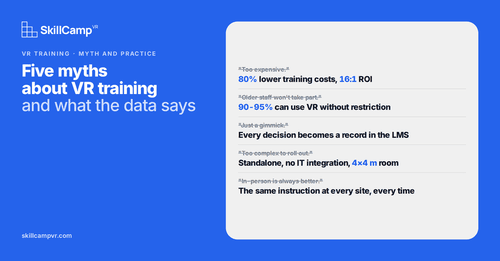
Five Myths About VR Training - and What the Deployment Data Actually Says
Too expensive, too complex, older staff will not take part: five objections to VR training checked against data from live deployments. With sources on cost, usability an
6 septembre 2026 · SkillCamp Redaktion
Lire la suite →Bereit, VR-Training in Ihrem Unternehmen einzusetzen?
Sprechen Sie mit unseren Experten und erfahren Sie, wie SkillCampVR Ihre Schulungen transformieren kann.