
Publication · 20 octobre 2026 · 5 min Lesezeit
AI in security guarding: why a ban is not enough
Many security officers ask private AI apps about rules, even where this is banned. What that means for client and site data, six questions to ask any AI provider, and how BDSW member companies can test a governed AI for three months free of charge.
Von SkillCamp Redaktion
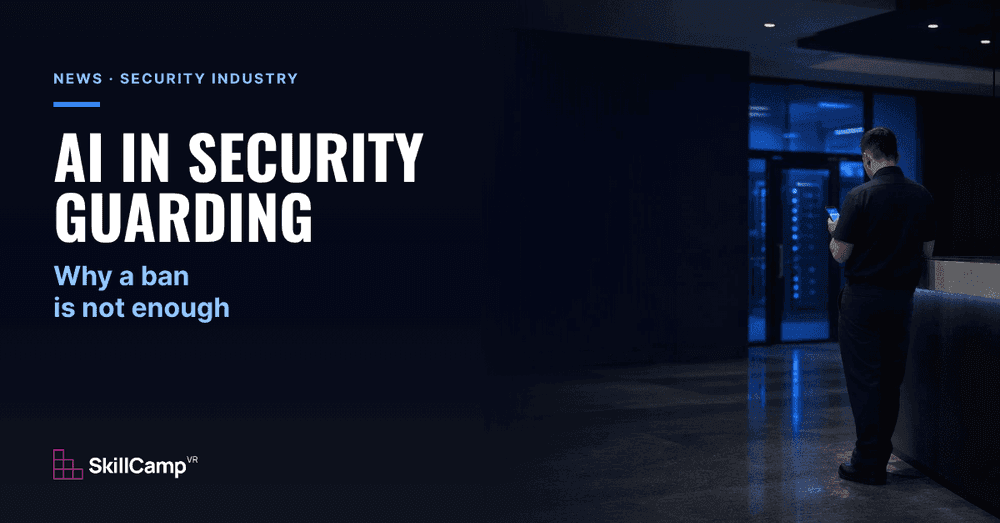
More and more security officers use artificial intelligence on duty, usually a private app on their own phone. They ask about a rule, get something translated or draft a report. On many sites this is banned. It happens anyway. For management and site leads, the question is no longer whether AI is arriving in security guarding, but how it is governed.
What the numbers show
For their Global Study 2025, KPMG and the University of Melbourne surveyed 48,340 people in 47 countries, including Germany. Among employees who use AI at work:
- 48 % have already entered confidential company data into public AI apps.
- 56 % have already made mistakes at work because of AI.
- 57 % have already used AI covertly, without disclosing it.
The most telling figure: in companies that ban AI, as many as 67 % have already entered company data into public AI apps. The study covers all industries, not only private security. But it shows that a ban on its own does little to change behaviour.
Three risks for security companies
Data leaving the company. Client and site data, such as access rules, alarm procedures or names, end up on third-party servers.
Made-up answers. The app does not know the post orders for the site. When in doubt, it gives an answer that sounds plausible but is wrong.
No oversight. Nobody in the company knows what was asked and what was answered. After an incident, there is no way to trace what the officer relied on.
Six questions to ask any AI provider (our recommendation)
If private apps are not the answer, you need a governed alternative. These questions help you assess offers:
- Where do the answers come from? Only from your approved documents, or also from the internet?
- Does it back up every answer? Does it name the section of the post orders, and what happens when there is no source?
- Does the model learn from your data? Your documents should not be used to train a model.
- How are companies, sites and areas separated? Reception does not need to see what applies to the executive floor, and other companies see nothing at all. The separation should be enforced technically, not just agreed on paper.
- **Where is the data stored, and who has access? **Data stored in the EU, a personal login for every officer, which can be blocked at any time.
- Who decides? The AI should not trigger anything. The officer on site makes the decision.
What this looks like on duty
2:40 a.m., data centre. A technician from an outside contractor wants to enter the server room. He is not on the access list and points to an urgent fault ticket from the client.
The officer asks the AI Operations Assistant by voice. Within seconds, the steps from the site’s own post orders appear:
- No access without authorisation, even under time pressure.
- Verify the job: call back the client’s on-call service on the number on file, not the number the technician gives.
- If authorised: record the ID, escort him to the server room, log the times.
- If not authorised: refuse access, inform the alarm receiving centre and site management.
Below the answer is the source: Post orders, data centre, section 3.1. If the assistant finds no source, it does not answer and refers the officer to the person in charge.
For the company, this means site and shift supervisors get fewer calls, including at night and for lone workers. Relief and stand-in officers find the rules from their first shift. And site knowledge stays when staff change. Every question is logged, with no performance rating of the officers.
And in training
The AI Learning Assistant works the same way, only for learning: with the industry’s standards, legal requirements and regulations, aligned with security academies. It answers subject questions around the clock, in the learner’s native language if needed. Learners ask what they would not ask in front of the group. And the most frequent questions show where training needs to be sharpened.
Both assistants run in the browser on a smartphone, tablet or PC, with no installation and no IT project. Operation is designed for compliance with the GDPR (General Data Protection Regulation).
Three months free for BDSW member companies
SkillCampVR from Munich is a member of the BDSW (Bundesverband der Sicherheitswirtschaft), the German Federal Association of the Security Industry. Eight of the ten largest security companies in Germany train on our platform. We offer every BDSW member company a three-month free trial of both assistants on one site, whether you employ 30 or 3,000 officers. Setup is free as well.
How the pilot works:
- Choose a site. You name a site and send the documents you already have, such as post orders, reporting and alarm procedures and emergency plans, as they are.
- Setup. We set up both assistants and give the officers a short introduction.
- Review. After three months, we review the results together. Then you decide.
To get started, a short email to Ruslan Dzhakhangirov with the site you would like to test is all it takes: ruslan.dzhakhangirov@skillcampvr.com, phone +49 89 201 75 116.
Weitere Artikel

The ROI of VR training: where the money actually comes from
The headset is rarely the cost that matters. Where VR training pays back in practice: shift cover, trainer time, travel, error risk and audit records. With the Securitas figures, an example calculation and the five numbers to collect for your own.
20 septembre 2026 · SkillCamp Redaktion
Lire la suite →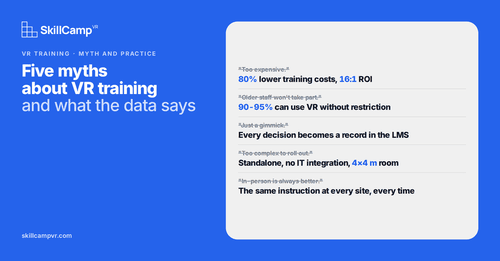
Five Myths About VR Training - and What the Deployment Data Actually Says
Too expensive, too complex, older staff will not take part: five objections to VR training checked against data from live deployments. With sources on cost, usability an
6 septembre 2026 · SkillCamp Redaktion
Lire la suite →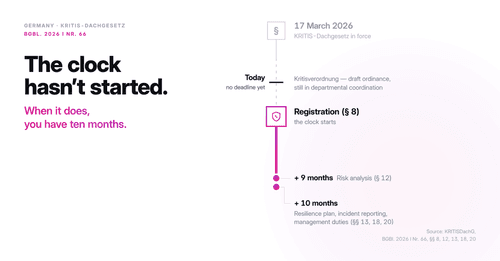
The KRITIS-Dachgesetz: The Personnel Measures Almost Nobody Is Planning For — and Why the Delay Is an Opportunity
The KRITIS-Dachgesetz has been in effect since March 17, 2026, but the ordinance defining critical facilities is still a draft. Registration isn't mandatory yet. Operators should use this valuable planning window now. Once the deadline starts, securing people—not fences—will be the hardest task.
9 août 2026 · SkillCamp Redaktion
Lire la suite →Bereit, VR-Training in Ihrem Unternehmen einzusetzen?
Sprechen Sie mit unseren Experten und erfahren Sie, wie SkillCampVR Ihre Schulungen transformieren kann.