
Events · November 11, 2026 · 5 min Lesezeit
De-escalation in care: why difficult moments should be practised before they happen
At Deutscher Pflegetag 2026, we showed a VR de-escalation training for care with MSE Group. Why tense situations are part of everyday care, what classroom training alone leaves open, and how online lessons, VR exercises and an AI assistant work together.
Von SkillCamp Redaktion
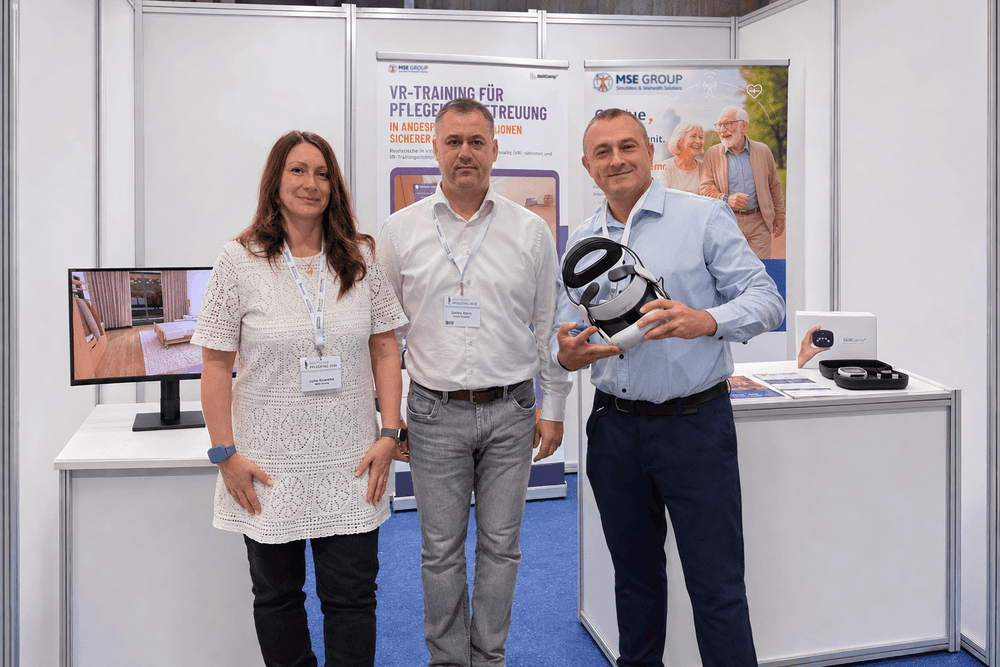
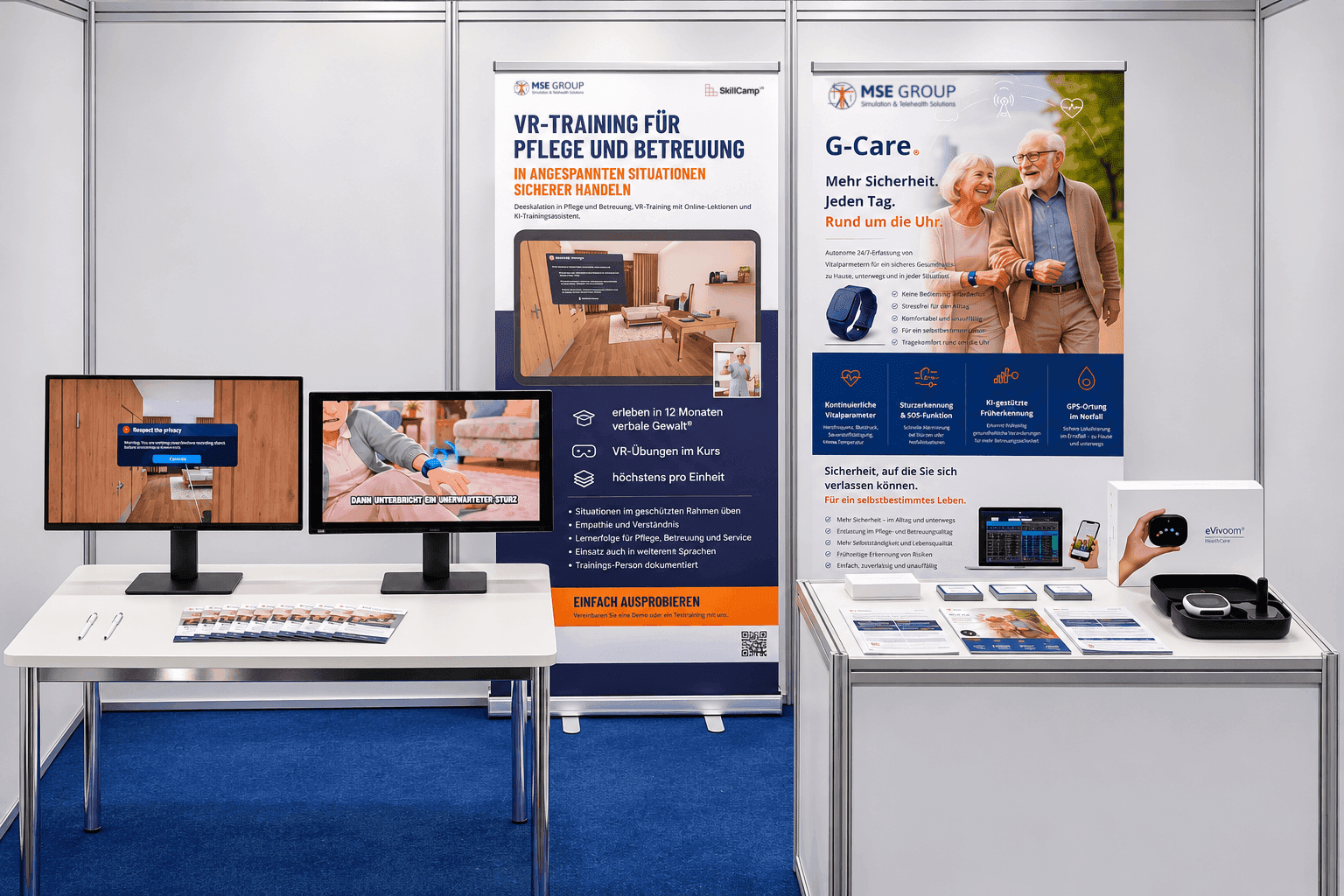
On 12 and 13 November 2026, Deutscher Pflegetag, Germany's national nursing congress, took place at hub27, Messe Berlin. Together with our partner MSE Group, we showed the training "De-escalation in Care and Support". Visitors to the stand could try the first VR exercise themselves.
Tense situations are part of everyday care
A resident does not want to go to lunch. Another refuses personal care. Relatives are upset because something did not go as they expected. In care and support, situations like these are not the exception. They are part of the daily routine.
The figures show how often they turn into more. In a survey of 1,984 staff in hospitals, elderly care and disability care in Germany, 94 % reported experiencing verbal violence within twelve months, and 70 % physical violence (Schablon et al., 2018). A meta-analysis of 253 studies worldwide found that 61.9 % of healthcare workers experience workplace violence within a year, most often verbal abuse (Liu et al., 2019).
Behind challenging behaviour there is often fear, pain, disorientation or a need nobody has noticed. Behaviour then becomes a form of communication. Staff who understand this and notice tension early can calm many situations before they tip over. That protects the care worker, and it protects the resident.
Knowledge alone does not carry the decisive moment
Many care providers have invested in de-escalation training for years, and rightly so. In these courses, teams learn what happens in tense situations and which strategies help.
In daily work, three gaps remain:
- Practice is rare. What was discussed in a seminar has to be available in the decisive moment, often under time pressure and alongside other tasks. That comes with repetition, and the opportunity for repetition is usually missing.
- Seminar days are hard to schedule. Many homes can barely organise a full day that takes the team out of the rota. New staff join all the time and wait for the next date.
- The whole house is involved. Housekeeping, kitchen, reception and maintenance staff meet tense situations too. When everyone means the same thing by early warning signs, stopping and the post-incident debrief, the team can act in a coordinated way.
Understand first, then practise, then consolidate
The training "De-escalation in Care and Support" combines three steps:
- Online lesson. 30 minutes at most, on a PC or smartphone: recognising causes and needs, noticing tension early, learning de-escalating strategies.
- Practice in the VR headset. The care worker stands right in the situation. She decides what to say and do, and sees how the resident responds.
- Consolidate and record. Access remains open for refreshers. Completed units and learning progress are recorded for each person on the learning platform.
An AI training assistant answers questions from the course material, also in other languages. This helps new and international staff in particular. For questions on diagnosis, medication or legal matters, it refers staff to the contact person in the home.
The course includes five VR exercises, ten lessons and three learning paths by role: service and support, care and support staff, and registered nurses. Two learning sessions a week are recommended. The course is completed in four to five weeks, without blocking a full seminar day in the rota. The course language is German.
What an exercise looks like
Mr K. lives with dementia. The care worker comes to take him to lunch. He holds on to his belongings: "I'm not going anywhere. Everything gets stolen here."
What do you say?
- A: "Nobody steals anything here. Please come with me."
- B: "You're worried about your things. Would you like to tell me what happened?"
- C: "Calm down, your lunch is getting cold."
Feedback follows. Answer B takes his feelings seriously without confirming or denying the accusation. Calm tone, short sentences.
Visitors in Berlin could try this scene themselves. Other situations in the course include refusal of personal care, a tense situation during a meal, an emotional conversation with relatives, a conflict between residents, unrest in the living area, a tense situation on a home visit and sexually inappropriate behaviour.
A complement, not a replacement
The digital training complements face-to-face training: prepare online, practise in VR, go deeper in the classroom. Protective, evasive and breakaway techniques should continue to be practised hands-on under expert guidance.
Teaching units are stated for each learning path. Whether the course is recognised as mandatory training is checked case by case.
The training was developed with expertise in de-escalation management and is aligned with the training guideline of NAGS Austria, Deutschland and Schweiz (2024).
Together with MSE Group
MSE Group brings the training to care providers in Germany and Austria: residential care, home care services, disability care, nursing schools and academies. The technology comes from SkillCampVR. Our platform is in daily use where conversations under pressure are part of the job, in security services and at German airports.
Thank you to everyone who came to our stand in Berlin, put on a headset and shared their questions and experience with us.
See it for yourself
Care providers who want to get to know the training can arrange a demonstration, at their own home or online. In 30 to 45 minutes, you try a VR exercise yourself and see an online lesson, the AI training assistant and the learning progress.
Get in touch via skillcampvr.com or directly through MSE Group.
Weitere Artikel
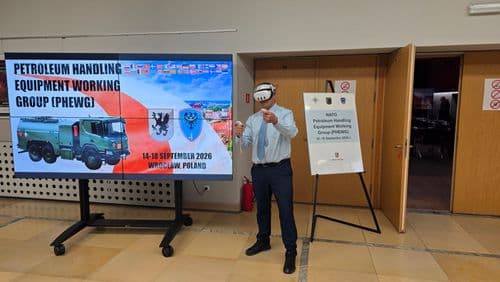
SkillCampVR at the NATO Petroleum Handling Equipment Working Group industry session in Wrocław
At the NATO Petroleum Handling Equipment Working Group meeting in Wrocław, SkillCampVR and UPLIFT INTERNATIONAL presented VR training for military fuel handling: the whole fuel chain, emergencies that cannot be practised live, and a record of competence.
October 12, 2026 · SkillCamp Redaktion
Read more →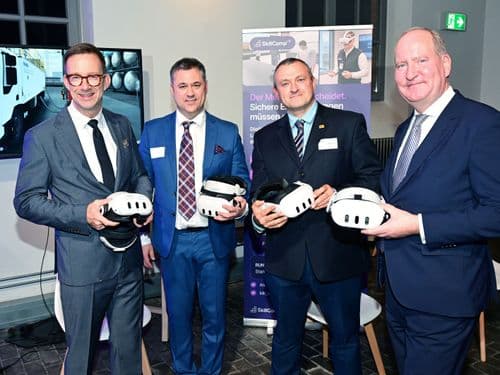
SkillCampVR at the BDL Abend der Luftfahrt 2026 in Berlin
At the German Aviation Association's Abend der Luftfahrt in Berlin, guests at the SkillCampVR station stepped into the security lane, the Aviathek and the basket of a de-icing truck. Why training capacity is a location factor and how the training works in daily operations.
October 5, 2026 · SkillCamp Redaktion
Read more →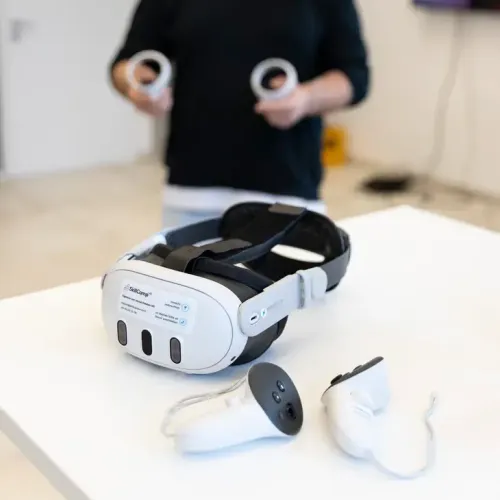
Innovative VR Training Solutions at Stölting Service Group
We demonstrated at Stölting Service Group how customized VR training solutions make the learning process more efficient and motivating.
November 26, 2025 ·
Read more →Bereit, VR-Training in Ihrem Unternehmen einzusetzen?
Sprechen Sie mit unseren Experten und erfahren Sie, wie SkillCampVR Ihre Schulungen transformieren kann.