
Events · 12 octobre 2026 · 6 min Lesezeit
SkillCampVR at the NATO Petroleum Handling Equipment Working Group industry session in Wrocław
At the NATO Petroleum Handling Equipment Working Group meeting in Wrocław, SkillCampVR and UPLIFT INTERNATIONAL presented VR training for military fuel handling: the whole fuel chain, emergencies that cannot be practised live, and a record of competence.
Von SkillCamp Redaktion
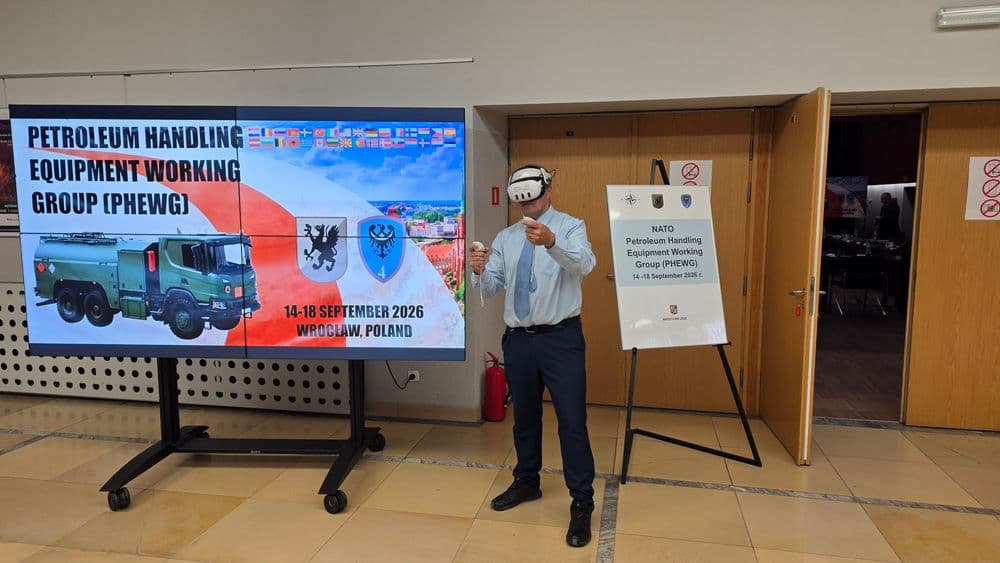
On 16-17 September 2026, SkillCampVR had the honour of taking part in the industry session during the NATO Petroleum Handling Equipment Working Group meeting in Wrocław, Poland. Together with our partner UPLIFT INTERNATIONAL, we presented how virtual reality can support education, training and evaluation in military fuel and fuel handling.
For our team, this was a proud moment. Presenting our work to the specialists who deal with fuel handling equipment and procedures every day is exactly the kind of room where training technology has to prove itself.
About the Working Group
The Petroleum Handling Equipment Working Group is a subordinate body of the NATO Operational Energy Committee, the Alliance's senior advisory body for logistic support on all matters concerning energy including petroleum. According to NATO, the group works to improve force effectiveness and interoperability through the standardisation of facilities, equipment and procedures for handling fuel and lubricant products. It meets once a year, with open sessions that include partner nations.
Standardised equipment and procedures only work if the people who operate them are trained to the same standard, at every base and in every unit. That is where training technology comes in, and it is the question our joint presentation addressed. We were proud to bring an answer that is already working in practice, not a concept on paper.
Why fuel handling is hard to train
Fuel handling is not one task but a chain, and every link in it is repeated daily, inspected, and dangerous to get wrong. Four things make it difficult to train well:
- The routine is constant, the emergencies are not. Crews handle fuel every day, but may never face an overfill, a hose burst or a spill with emergency shut-off. These high-consequence, low-frequency events are exactly the ones that cannot be staged live.
- Units are distributed. The same procedure has to be applied identically at every base, on every shift and at deployed sites, while training quality depends on local instructors, local equipment and the local calendar.
- Attendance is not competence. A unit usually knows who attended a course. It rarely knows who can still do the job.
- Practical training is expensive. It burns fuel, takes vehicles off the line, ties up instructors and requires travel.
The whole fuel chain, not only the aircraft
The approach we presented covers the full set of fuel handling activities, each as its own training scenario:
- Receipt and storage - road, rail, pipeline, tank farm and custody records.
- Fuel quality control - sampling, grade, water and particulates, release to use.
- Distribution - vehicle loading, depot and hydrant operation.
- Aircraft refuelling - checks, bonding, pressure refuelling, deadman, disconnect.
- Deployed operations - deployable installations, light discipline, allied types.
Every role in the chain can be trained: operator, quality control, depot, deployed personnel and supervisors. Alongside the standard workflow, each scenario includes the situations that cannot be tested under real-world conditions: overfill, spill during transfer, wrong fuel grade, equipment malfunction, wrong sequence, fire and emergency shut-off. They can be met many times in training, before being met once for real.
How a training session works
A trainee puts on a headset and works through a session of about twenty minutes. Theory and procedure come first, then the full task is performed in the conditions of the task, then the result is assessed. An AI assistant guides the trainee during the session and gives feedback on the exercise afterwards.
The trainee works on a virtual model of the vehicle the unit actually operates, not a generic one. Where the manufacturer's 3D data exists, it is used. Where it does not, our team surveys the vehicle on site with measurements, photos and video, and builds the model itself. Procedure comes from live daily fuelling operations, and national military rules and the unit's own procedures are applied on top. When new equipment, procedures or aircraft types arrive, they are added to the same platform rather than rebuilt from scratch.
Because the training runs on headsets, it can be delivered where the crews are, including deployed sites. Reachback to the specialist replaces moving personnel to the specialist.
Evidence of competence, not attendance
Every action in the simulation is captured: what was done, in what order and when. In fuel handling the order is the procedure, so the sequence is scored, and safety-critical steps pass or fail on their own. Faults and equipment condition change from run to run, so a memorised run does not pass.
The learning management system keeps the record: a score per session, a step-by-step log, and currency by individual, by crew and by unit. It shows who has kept the standard and who is due for refresher training. Hosting of training records is agreed with the customer, including national and on-premise options.
The simulation does not replace the instructor. It records what the instructor does once and makes it available to every unit, as often as required. The system produces the evidence, and the certification decision stays with the instructor.
What a unit receives
- Scenario catalogue - the fuel handling scenario library, extended over time.
- VR LMS - central management, reporting, certificates and compliance tracking.
- Headsets - delivered plug and play, with logistics, setup and support.
- AI assistant - guidance during the session and performance feedback.
- Dedicated support - onboarding, rollout planning and ongoing support.
Rollout follows four steps: site assessment, scenario customisation, on-site deployment and continuous improvement.
Three kinds of expertise, one solution
The approach brings together three partners, none of which could have built it alone. UPLIFT INTERNATIONAL, a Belgian fuelling group operating depots and into-plane fleets, brings procedure and apron practice from live daily operations. JM Enterprise, the Italian manufacturer of refuellers and dispensers led by CEO Alexandru Sturza, brings the equipment engineering behind the virtual vehicles. SkillCampVR builds the simulation, the scenarios and the learning management system.
Already in service
This is not a pilot. SkillCampVR training has been in service since 2019, including at Bundeswehr sites. In aviation ground operations at Frankfurt Airport, more than 450 personnel have been trained with it across two seasons.
Based on UPLIFT operational figures and independent research on VR learning (PwC), simulation-based training can reduce training time by around 40% and bring trainees to competence up to four times faster.
Thank you
We are proud to have presented alongside UPLIFT INTERNATIONAL, and grateful for the trust behind it. Our thanks go to Philippe van Exem and Pieter Van Espen in particular, for making our participation possible and for the joint presentation. Thanks also to Alexandru Sturza, CEO of JM Enterprise, and his team, whose equipment engineering is part of every virtual vehicle we showed.
Wrocław was an important step for us, and we look forward to continuing the conversations that started there.
See it for yourself
Organisations that want to see the training in practice can arrange:
- A technical exchange - a working session with their engineering and fuel staff.
- A demonstration at their own location - with equipment and headsets, used by their own operators.
- A reference visit - including Ostend, Malta and the platform at Frankfurt Airport.
Get in touch via skillcampvr.com.
Weitere Artikel
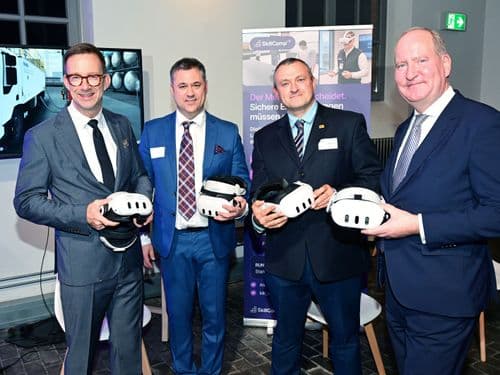
SkillCampVR at the BDL Abend der Luftfahrt 2026 in Berlin
At the German Aviation Association's Abend der Luftfahrt in Berlin, guests at the SkillCampVR station stepped into the security lane, the Aviathek and the basket of a de-icing truck. Why training capacity is a location factor and how the training works in daily operations.
5 octobre 2026 · SkillCamp Redaktion
Lire la suite →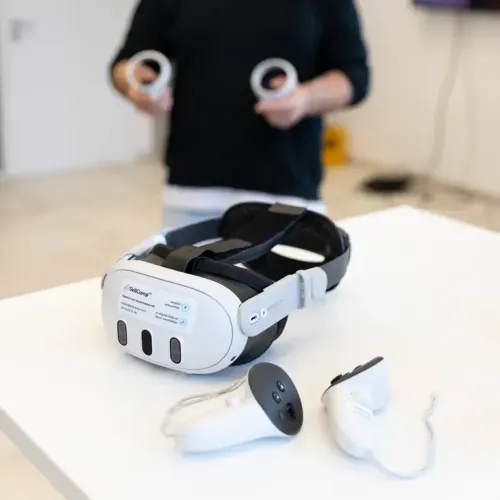
Innovative VR Training Solutions at Stölting Service Group
We demonstrated at Stölting Service Group how customized VR training solutions make the learning process more efficient and motivating.
26 novembre 2025 ·
Lire la suite →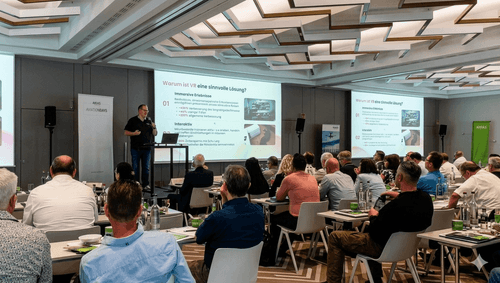
AWiAS Aviation Days 2025 in Hamburg – Virtual Reality Training für die Luftsicherheit im Fokus
Bei den AWiAS Aviation Days 2025 in Hamburg präsentierte SkillCampVR, wie VR das Training in der Luftsicherheit effizienter und zukunftsfähig macht.
18 juin 2025 · SkillCamp Redaktion
Lire la suite →Bereit, VR-Training in Ihrem Unternehmen einzusetzen?
Sprechen Sie mit unseren Experten und erfahren Sie, wie SkillCampVR Ihre Schulungen transformieren kann.